

We used to treat screenshots like receipts. Not perfect, not official, but close enough for most human purposes. A rectangle of pixels could settle an argument in a group chat, confirm that a promise was made, or show that someone crossed a line. People still share screenshots the same way they pass around eyewitness accounts: with a little flourish, a little certainty, and the quiet assumption that seeing is believing.
That assumption is fraying. Not because everyone suddenly became a liar, but because the tools got better and the context got thinner. A screenshot arrives divorced from the device, the time, the network, and the messy chain of custody that used to give evidence its weight. It looks like a conversation, and that is often enough to do damage.
Now add encryption to the story, the kind that apps like Signal champion. Privacy is the point, and the point is good. But privacy also rearranges what can be proven to third parties. We have built rooms where outsiders cannot listen in, and then we ask outsiders to judge what happened inside.
The screenshot as social currency
Screenshots became popular not because they were rigorous, but because they were easy. They are the coin of online conflict and online comedy. Post one and you can win an argument before the other person has finished typing. Or you can turn a private moment into a public artifact, a little trophy of being right, wronged, or just entertained.
The trouble is that the same qualities that make screenshots shareable make them forgeable. The aesthetic is simple: a colored bubble, a timestamp, a read receipt. If the story looks familiar, the brain relaxes. A screenshot doesn’t need to convince a court. It just needs to convince the group chat, or the comment section, or an employer who is already nervous.
And the modern internet runs on nervousness.
Plausible forgeries and the performance of authenticity
We have entered an era of “plausible forgeries,” not necessarily masterpieces, just fakes that clear the low bar of social believability. The clever part isn’t the typography. It’s the way the forgery anticipates the audience’s expectations. The sender uses a name you recognize. The tone matches how that person might speak. The time stamp is late at night, when people do dumb things. The message includes a detail that feels too specific to invent.
When a forgery is good, it doesn’t feel like an imitation. It feels like a revelation.
Tools that generate chat mockups are not sinister by default. They serve obvious, often harmless needs: memes, pranks between friends, storyboarding, classroom examples, UX wireframes, social media skits, even film and TV props where no one wants to accidentally display a real conversation. A site offering a fake signal chat template, alongside a dozen other platforms, sits in the same ecosystem as a fake newspaper front page generator or a fake receipt maker. It is a prop shop for the internet.

fakechatgenerators.com lets you mock up chat screenshots across 16 platforms
But props have a way of wandering offstage.
Signal’s paradox: privacy that weakens proof
Signal’s selling point is not that it produces better evidence. It is that it produces less evidence. Messages disappear. Metadata is minimized. End-to-end encryption blocks intermediaries from reading along, which is exactly what many people want when they are discussing sensitive topics. Journalists. Activists. People in abusive situations. Friends talking about things they are not ready to publish.
Yet when something goes wrong, the desire flips. We want verification. We want a judge, a moderator, a manager, a friend, to say what happened. Privacy gave us safety, but it also removed the easy third-party corroboration that makes accusations easier to evaluate.
This is not a moral failure of encryption. It is simply the trade we made. If a system is built to prevent outsiders from seeing, then outsiders cannot easily confirm. That is the cost of building rooms that lock from the inside.
And so we fall back on screenshots, which are not proof so much as theater. The bubble style and the tiny lock icon carry an aura: “This is private, therefore it must be real.” That is the paradox. The very brand of privacy can become a credibility costume.
Verification used to be slow, and slowness was a filter
In the physical world, verification had friction. A forged letter needed paper, ink, handwriting practice, a plausible envelope. A doctored photo required darkroom skills or careful editing. The effort acted as a crude filter. The fact that someone went to the trouble told you something, even if it didn’t tell you the truth.
Digital life removed the friction. That is largely good. It democratized expression and lowered the barrier to creativity. But it also democratized forgery. When the cost of producing a convincing artifact drops close to zero, the artifact loses its evidentiary premium. It becomes, at best, a clue.
This is the quiet shift many people have not emotionally processed. We still feel that a screenshot is weighty, because it looks like the kind of thing that used to be hard to fake. Our instincts lag behind our tools.
The ethics of “just a meme” in a world that believes images
A lot of forgery starts as play. A joke screenshot shared in a small group, made to poke fun at a friend. A skit made for engagement. A classroom exercise about misinformation. The maker knows it is fake. The first audience knows it is fake. Then it escapes.
It escapes because content moves faster than context. A screenshot is stripped of the caption that said “obviously fake.” It is reposted by someone who missed the wink. Or reposted by someone who did not miss it and simply does not care.
That is how rumor becomes narrative. Not through a single grand deception, but through a thousand small acts of careless redistribution.
The ethical question is not, “Is it legal to make a fake chat for a joke?” The ethical question is, “What downstream harms are you comfortable enabling?” Because the downstream harms no longer require malice. They require only indifference.
The counterforce: detection as a new kind of gatekeeping
Enter the detectors. If forgeries are becoming easy, the obvious response is to make verification easier too. AI-based tools now promise to evaluate whether an image is synthetic, manipulated, or tampered with. Some are tailored to media organizations, banks, marketplaces, and trust and safety teams, where speed matters and errors have real costs.
One example is a service offering ai image detection, positioned as a fast screening layer that flags AI-generated media, NSFW content, violence, and document tampering. It advertises 98.7% detection accuracy across more than 50 generative models, with sub-150ms latency. Those numbers are attractive because they speak the language of modern operations: scale, automation, and quick triage. A human can’t manually vet everything, and most platforms learned that lesson the hard way.
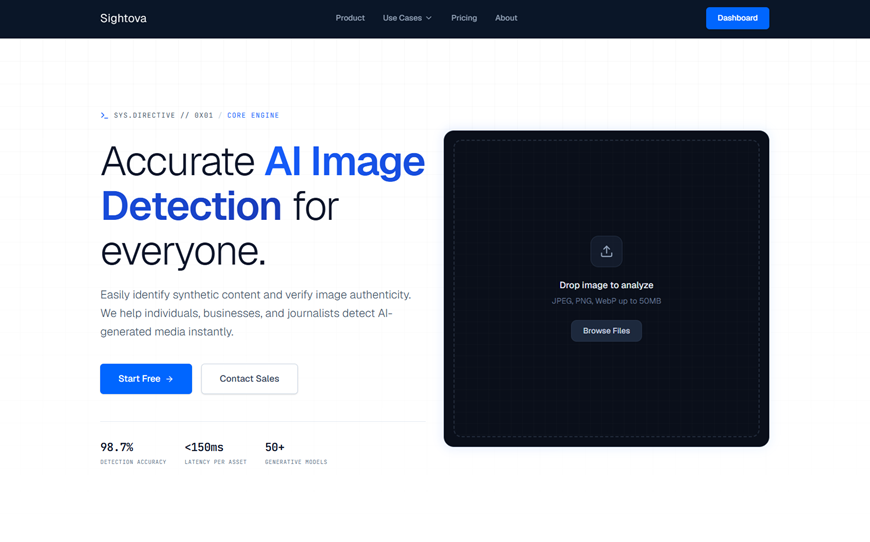
sightova.com flags AI-generated, tampered, NSFW, and violent imagery in milliseconds
But detection introduces its own philosophical knot. It shifts the question from “What happened?” to “What does the tool think happened?” The detector becomes an authority, and authorities have failure modes.
The new dilemma: skepticism that curdles into cynicism
When forgery becomes common knowledge, people become cautious. That is healthy up to a point. Past that point, caution turns into cynicism, the belief that nothing can be known and therefore nothing needs to be answered.
This is an old move, familiar in politics and personal disputes alike. If you can’t prove it, it didn’t happen. If you can’t prove it, you’re lying. If you can’t prove it, it’s “just drama.” Plausible deniability used to be something powerful people enjoyed. Now it is a cheap commodity.
Detectors can help, but they also create a new escape hatch. If the detector flags something, the accused can say, “It’s fake.” If it doesn’t flag something, the accuser can say, “It’s still fake, your tool just missed it.” The dispute migrates upward into arguments about methodology, thresholds, and bias. Ordinary people, watching this unfold, retreat. They start to treat every allegation like a marketing claim: interesting, but unverified, therefore ignorable.
The danger is not that we become gullible. The danger is that we become numb.
What counts as evidence in a private world?
It might be time to admit that the screenshot was never a robust form of evidence. It was a convenience. In a world where convenient evidence is easily forged, we have to lean on other forms of corroboration.
Sometimes that means technical artifacts: original files, device metadata, logs, export formats, cryptographic signatures, or trusted timestamps. Sometimes that means social corroboration: multiple independent accounts, consistent behavior over time, contemporaneous messages to third parties (“I can’t believe they said that”), or patterns that match known dynamics (coercion, harassment, manipulation).
None of these are perfect. That is the point. The work of verification is not to find a flawless artifact. It is to weigh an ecosystem of imperfect signals.
Signal, in particular, challenges us because it is designed to leave less behind. Disappearing messages are humane in intimate life, but they frustrate retrospective accountability. We want people to have the right to forget, and we also want the right to prove. Those desires collide more often than our product slogans admit.
A modest proposal: treat private screenshots as claims, not conclusions
A private chat screenshot should be treated like a spoken accusation: something that may be true, something that may be false, and something that requires careful handling either way. It should not be treated as a final verdict. The internet is built to turn artifacts into verdicts quickly, because outrage is efficient. But quick verdicts are often wrong, and being wrong at scale is not a minor mistake.
For individuals, the discipline is simple and hard. Pause before you repost. Ask what you would need to see if the screenshot targeted you. Consider how easily you could fabricate the same thing, with the same font and same timestamp, on a lazy afternoon.
For institutions, the discipline is procedural. Establish standards for intake, triage, and escalation. Use detection tools as aids, not oracles. Train humans to look for context, not just pixels. Create room for uncertainty, and resist the public pressure to pretend certainty where it does not exist.
The human part we cannot automate
Even if detectors become remarkably accurate, the deepest problem remains social, not technical. Trust is not just about whether an image is authentic. Trust is about whether a person is reliable, whether a platform incentivizes honesty, whether a community punishes truth-telling, whether the costs of speaking are survivable.
Encryption did not create this problem. It merely highlighted it. If private conversation is going to be genuinely private, then society must accept that not everything can be cleanly adjudicated by outsiders. That is uncomfortable, especially for people who have been harmed and need others to believe them. It is also uncomfortable for people who are falsely accused and need others to doubt.
The tension is real: belief can be weaponized, and skepticism can be weaponized too.
So we arrive at a modern verification dilemma. We built tools to protect our private words, and we built tools to forge the artifacts of those words. Now we are building tools to detect the forgeries. Around and around it goes, a technical arms race that never quite reaches the moral center of the matter.
The moral center is slower. It lives in habits, norms, and restraint. It lives in the willingness to say, “I don’t know,” and to keep caring anyway.